Media Education in Minority Languages
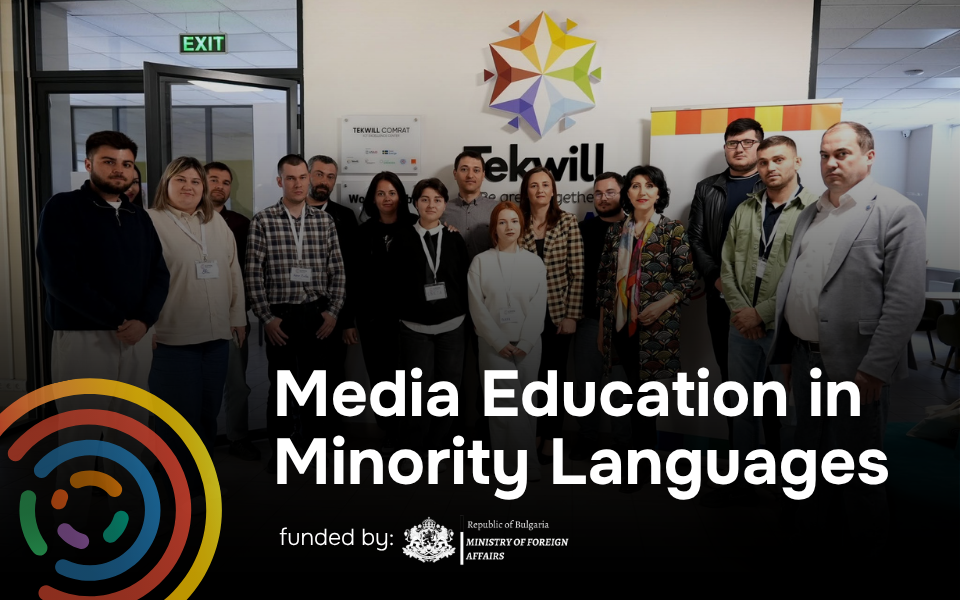
The “Media Education in Minority Languages” project was implemented by the Centre for Civic Initiatives for National Minorities with the support of the Government of the Republic of Bulgaria.
The problem addressed by the project: In the Republic of Moldova, ethnic minorities, particularly in regions where they live in compact communities, such as the districts of Taraclia, Basarabeasca, Edineț, Drochia and the Autonomous Territorial Unit of Gagauzia, face limited access to quality, reliable and understandable information in their native languages. The information environment in these regions is largely filled with external sources that often disseminate propagandistic or manipulative narratives, making the local population more vulnerable to disinformation. An additional problem is the low level of media literacy among different age groups, especially young people and older generations. In many cases, people lack the skills to critically analyse information, verify sources and recognise manipulative content. This leads to the formation and spread of distorted perceptions of political, social and international processes, increases distrust in state institutions and independent media and deepens social and interethnic divisions.
In addition, the education system has almost no adapted and accessible media literacy tools in minority languages, particularly in interactive and modern formats that would be attractive to school students and young people. This limits opportunities to develop strong critical-thinking skills from an early age.
The objective of the project is to increase media literacy among Moldova’s ethnic minorities, strengthen their resilience to disinformation and propaganda and create accessible, high-quality media content in native languages that contributes to the development of critical thinking and active civic participation.
As part of the project, more than 30 video materials in minority languages were produced, focusing on countering propaganda and disinformation and increasing media literacy among ethnic groups of different ages.
The media campaign generated more than 600,000 views, significantly expanding audience reach in regions with predominantly minority populations, increasing trust in independent sources of information and stimulating public discussions about the critical understanding of information. The content was actively distributed through social networks and local media, strengthening the information presence of minority languages, where there had previously been a shortage of quality content.
The project also organised the country’s first Media Education Hackathon in minority languages. The hackathon took place in 20 localities with predominantly minority populations in the districts of Taraclia, Basarabeasca, Edineț and Drochia, as well as in the Autonomous Territorial Unit of Gagauzia.
The event targeted school-age young people aged 15–18 and brought together more than 500 participants in total. During the hackathon, participants developed their own mini-projects aimed at combating disinformation, gained practical skills in analysing media content and became local media literacy ambassadors in their communities. This contributed to the development of a new generation of young leaders capable of critically assessing information and influencing the information environment in their regions.
Furthermore, the project created the country’s first media education comic in the Bulgarian language. With the support of the Ministry of Education of the Republic of Moldova, it was distributed to all schools attended by children of Bulgarian origin. This tool became an innovative educational format adapted to school audiences and enabled media literacy elements to be integrated into the educational process in an accessible and interactive way.
The project represented one of the first systematic steps towards developing media literacy specifically in the languages of national minorities in the Republic of Moldova. As a result:
- access to quality information in minority languages was significantly expanded;
- critical thinking among young people and the wider public was strengthened;
- a network of young participants and activists involved in promoting media literacy at the local level was created;
- the role of civil society in countering disinformation in vulnerable regions was strengthened;
- sustainable educational and media tools—video content and a comic—were created and continue to be used after the project’s completion;
- cooperation with state institutions, particularly the Ministry of Education, was strengthened, increasing the potential to scale similar initiatives nationally.
The project demonstrated that developing media literacy in native languages is a key factor in increasing society’s resilience to information threats and strengthening social cohesion.