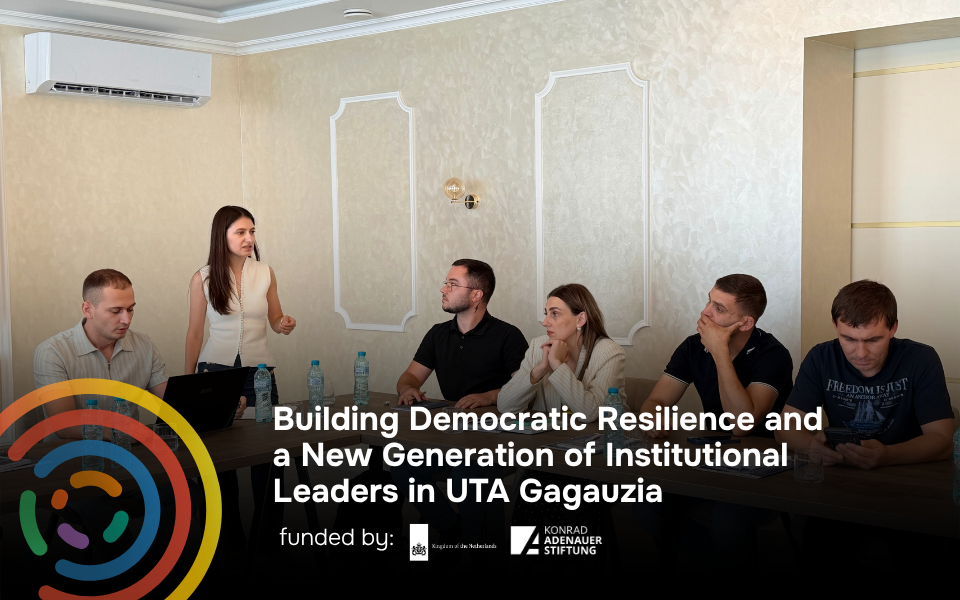
Building Democratic Resilience and a New Generation of Institutional Leaders in UTA Gagauzia
The project “Strengthening Democratic Resilience and Building a New Generation of Institutional Leaders in the ATU of Gagauzia” is implemented by the Centre for Civic Initiatives for National Minorities (ICPMN), with the support of the Kingdom of the Netherlands.
The project represents a comprehensive, long-term programme for preparing a new generation of civic, political and institutional leaders in the ATU of Gagauzia. Its central idea is to create a “professional talent pool” of young people in the region who possess knowledge about the functioning of the autonomy and the state institutions of the Republic of Moldova, understand democratic processes and are able to participate professionally in the region’s public, political and administrative life in the future.
The programme is built on the principle “from knowledge — to practice — from practice — to one’s own initiatives” and combines intensive training, public debates, direct work with citizens, professional internships in public institutions and civil society organisations, research activities and the implementation of participants’ own Community Action Labs.
The problem addressed by the project
The ATU of Gagauzia is one of the most politically sensitive regions of the Republic of Moldova. With an autonomous status established by the Constitution and its own regional institutions, the autonomy is also facing a range of political, informational and institutional challenges that directly affect the quality of democratic governance and the resilience of the region.
One of the most serious challenges remains the information environment. The region’s significant dependence on the Russian-language information space, the spread of disinformation about the European Union and the European integration process of the Republic of Moldova, the use of identity-related issues for political mobilisation and the lack of professional public dialogue create favourable conditions for political polarisation.
External influence is spread not only through traditional media, but also through social networks, political actors, information campaigns and other channels. As a result, distrust in national institutions increases, political discourse becomes more radicalised and constructive dialogue between Comrat and Chișinău becomes more difficult.
However, the problem is not limited to the region’s informational vulnerability.
One of the most serious long-term challenges is the lack of systematic preparation of a new generation of professional leaders capable of working in the future within the institutions of the autonomy, local authorities, civil society, media and other structures.
In Gagauzia, there is limited generational renewal within public institutions, a lack of a systematic talent pool, insufficient understanding among young people of the autonomy’s legal system, a low level of political literacy and limited opportunities to gain practical experience in working with legislative and administrative processes.
As a result, some young people distance themselves from politics and public life, perceiving them as a toxic and closed environment. Others become involved in political processes through emotional and populist narratives, without having a sufficient understanding of how public authorities actually function, what powers different institutions have and how citizens can influence decision-making.
This situation creates long-term risks for the autonomy itself: weakened institutional resilience, a decline in the quality of political dialogue, further polarisation of society, dependence on external informational and political influences and a shortage of professional staff for public administration.
Therefore, the project approaches youth leadership not only as a matter of developing individual young people, but also as a matter of the long-term democratic and institutional resilience of the ATU of Gagauzia.
Project objective
The main objective of the project is to build a new generation of professionally prepared, politically literate and democratically oriented young leaders capable of contributing to the development of the ATU of Gagauzia and strengthening its institutions.
To achieve this objective, a twelve-month programme was developed, combining specialised education, practical exposure to the work of public institutions, public debates, interaction with citizens, internships and the implementation of participants’ own initiatives.
In the long term, the project aims to create a sustainable professional talent pool of young specialists capable of working in local and regional authorities, the People’s Assembly of Gagauzia, civil society, media and other institutions.
1. Building a new generation of leaders
The project’s central target group consists of young people from the ATU of Gagauzia who are interested in the public, political and civic life of the region.
Participants are selected through a competitive process, taking into account their motivation, civic engagement and potential for further professional development and participation in the life of the autonomy.
It is particularly important that the project focuses on a new cohort of young people who have not previously participated in earlier stages of the programme. In this way, ICPMN consistently expands the community of young civic and political leaders in the region instead of working with the same limited group of activists.
Participants go through the full cycle—from acquiring basic and specialised knowledge to direct interaction with state institutions and the implementation of their own public initiatives.
2. Intensive educational programme
The first major component of the project is a five-month educational cycle consisting of five intensive two-day modules.
The programme was designed to provide participants with a systematic understanding of how the autonomy functions and what place it occupies within the constitutional and administrative system of the Republic of Moldova.
The first educational block focuses on the legal and institutional foundations of the ATU of Gagauzia. Young leaders study the legal status of the autonomy, the distribution of powers, the functions of regional institutions and the specific features of relations between Comrat and Chișinău.
The second area concerns public administration. Participants become familiar with the governance system at the local, district, municipal, regional and national levels, budgetary and administrative processes, the powers of the People’s Assembly of Gagauzia and the limits of the competencies of different institutions.
The third block focuses on political leadership and democratic participation, including political campaigns, elections, communication with voters, public speaking, strategic communication and mechanisms for engaging citizens.
The programme also covers crisis management and countering disinformation.
The main task of the educational component is not merely to familiarise participants with theoretical concepts, but to develop institutionally literate young leaders who understand where political slogans end and real powers, legislation, budgets, responsibility and public administration mechanisms begin.
3. The legal status and actual powers of the autonomy
The programme pays particular attention to understanding the autonomy itself.
Political discussions in Gagauzia often focus on the region’s powers, its relations with central authorities and the interpretation of its autonomous status.
Therefore, participants study in detail:
- the legal basis of the ATU of Gagauzia;
- the distribution of powers between central and regional institutions;
- the functions of the People’s Assembly of Gagauzia;
- the local public administration system;
- administrative and budgetary processes;
- institutional relations between Comrat and Chișinău.
This approach should help young people form their political positions on the basis of legislation and real institutional mechanisms, rather than exclusively on emotional or manipulative narratives.
4. Political Leadership and Democratic Participation
The second major area of preparation focuses on practical politics.
Participants learn how a political programme is developed, how an electoral campaign is organised, how to work with voters, how to conduct public communication and how a political leader should interact with the community.
At the same time, the project does not support any political party or political movement.
Its purpose is to show young people how the democratic political process functions, what rules, institutions and accountability mechanisms exist, and how political competition can be built around programmes, arguments and solutions rather than exclusively around identity, conflict and geopolitical polarisation.
5. Public Debates in Gagauzia
After completing the main educational cycle, participants move from theory to public practice.
A series of regional public debates and discussions is planned in different localities across the autonomy.
Participants receive specialised training in debating and public communication and then become directly involved in organising and conducting the discussions.
The purpose of this component is to gradually change the nature of public political dialogue in the region: from emotional confrontation to discussions based on arguments, facts and concrete proposals.
The project includes at least 5 public debates, involving more than 300 residents of the region. The results of the discussions will be systematised in the form of recommendations.
This gives young leaders the opportunity not only to speak among themselves, but also to interact directly with residents of the autonomy, hear about their problems, answer questions and learn to defend their positions publicly.
6. Professional Internships
One of the most important elements of the programme is the transition from educational simulation to real institutional practice.
After completing the educational programme and public debates, participants will have the opportunity to undertake professional internships lasting up to two months.
The host institutions will include:
-
the Parliament of the Republic of Moldova;
-
the Comrat Municipal Hall;
-
the Ceadîr-Lunga Municipal Hall;
-
civil society organisations;
-
media organisations.
The internships allow participants to see from the inside how decisions are made, how public administration works, how documents are prepared, how institutions interact and how the daily work of public and civil society structures is organised.
This is essential for the project: a young person should not only know theoretically how the state works, but also see this process with their own eyes.
This format also helps reduce the distance between young people from Gagauzia and national public institutions and supports the development of professional contacts that participants can use in the future.
7. Community Action Labs — From Learning to Change in the Community
A distinct practical component of the programme is represented by Community Action Labs.
After gaining knowledge and institutional experience, participants move on to independent work in their own communities.
They develop small civic initiatives aimed at solving concrete problems, increasing civic participation and improving the population’s political literacy.
Community Action Labs may include:
-
door-to-door consultations with residents to identify community problems;
-
campaigns encouraging young people to participate in public life;
-
public meetings and discussions about local development;
-
initiatives focused on transparency and accountability of local authorities;
-
educational activities about the work of state institutions;
-
initiatives aimed at increasing political literacy;
-
campaigns against disinformation and manipulation;
-
meetings between citizens and representatives of local authorities;
-
civic initiatives aimed at solving specific local problems.
Community Action Labs transform participants from recipients of an educational programme into independent organisers of change.
This format also allows them to test their knowledge in practice: a young leader must identify a problem, speak with residents, develop an intervention format, organise an event or campaign and achieve a concrete result.
8. Research into the Challenges of Contemporary Gagauzia
Another important result of the programme will be the preparation of a comprehensive analytical product—an Analysis Study dedicated to the current problems and challenges of the Autonomous Territorial Unit of Gagauzia.
Programme participants will be involved in analysing the situation in the region and developing research materials.
The study should help move from general political discourse about the “problems of Gagauzia” towards a more structured analysis of specific institutional, social and political challenges.
In addition to the general study, participants will develop their own political, civic, analytical or media products, including research papers, analytical materials, video campaigns and other initiatives addressing current regional issues.
9. Creating a Professional Talent Pool
One of the most important long-term results of the project should be the creation of a regional talent pool of young professionals.
The project understands this talent pool not as a formal list of participants, but as a community of young people who:
-
understand the legislation and legal status of the autonomy;
-
know the structure and powers of public authorities;
-
have experience interacting with state institutions;
-
are able to analyse public policies;
-
know how to work with citizens;
-
possess public communication skills;
-
are able to recognise manipulation and disinformation;
-
have practical experience in civic or political activities.
In the future, these young professionals may work in local authorities, the People’s Assembly of Gagauzia, national public institutions, civil society and the media, or independently develop civic and political initiatives.
10. Alumni Network and Programme Sustainability
The project should not end with the final educational module or internship.
The programme provides for the creation of an Alumni Network bringing together project participants and creating a basis for their future cooperation.
At the same time, the project develops formal partnerships with public and local institutions involved in the educational and internship programmes.
This creates an infrastructure that can be used to prepare future generations of young leaders in Gagauzia.
In the long term, the knowledge gained, professional contacts, Analysis Study, individual participant products and alumni network should continue to function after the project funding ends.
Expected Project Results
By the end of the full twelve-month cycle, the project aims to achieve:
-
the preparation of a new generation of young civic, political and institutional leaders in the Autonomous Territorial Unit of Gagauzia;
-
the completion of five intensive educational modules on the legal foundations of the autonomy, public administration, political leadership and democratic participation;
-
a significant increase in participants’ legal, institutional and political literacy;
-
the organisation of at least 5 public debates and discussions in different localities of the autonomy;
-
the involvement of more than 300 citizens in discussions about current regional issues;
-
the organisation of professional internships in the Parliament of the Republic of Moldova, local authorities, civil society and the media;
-
the implementation of at least 10 Community Action Labs developed by the participants themselves;
-
the preparation of a comprehensive Analysis Study on the current challenges facing the Autonomous Territorial Unit of Gagauzia;
-
the creation of individual analytical, civic and media products by young leaders;
-
the establishment of a sustainable Alumni Network;
-
the development of institutional cooperation between young people from Gagauzia, local authorities, civil society and national public institutions;
-
the creation of a foundation for a permanent professional talent pool of young regional leaders.
The quantitative indicators included in the project provide for 20 graduates of the full programme cycle, 5 regional debates, 20 professional internships, one comprehensive Analysis Study, 10 Community Action Labs and at least 5 formalised partnerships with host institutions.
Long-Term Significance of the Project
Building Democratic Resilience and a New Generation of Institutional Leaders in UTA Gagauzia is based on the idea that the region’s democratic resilience depends not only on legislation and formal institutions, but primarily on the people who will work within these institutions in the coming years.
If a new generation enters public and political life without understanding legislation, the powers of public authorities and democratic procedures, the political space can easily be filled by populism, disinformation and external manipulative narratives.
Therefore, the project invests in the human capital and institutional future of the autonomy.
Young people gradually move from studying Gagauzia’s legal status and public administration mechanisms to taking part in public debates, working directly with citizens, completing internships within real institutions and implementing their own initiatives.
As a result, a generation of young people is formed that is able not only to criticise the existing system, but also to understand it, work professionally within it and propose realistic ways to improve it.
In a broader context, the project aims to strengthen Gagauzia’s democratic resilience, increase the professionalism of regional governance, reduce young people’s vulnerability to disinformation and political manipulation, and develop more meaningful dialogue between Comrat and Chișinău.
The project’s main long-term investment is a new generation of leaders for whom the development of Gagauzia is connected to professional governance, accountability to citizens, democratic institutions and the ability to engage in constructive dialogue both within the autonomy and with the rest of the Republic of Moldova.