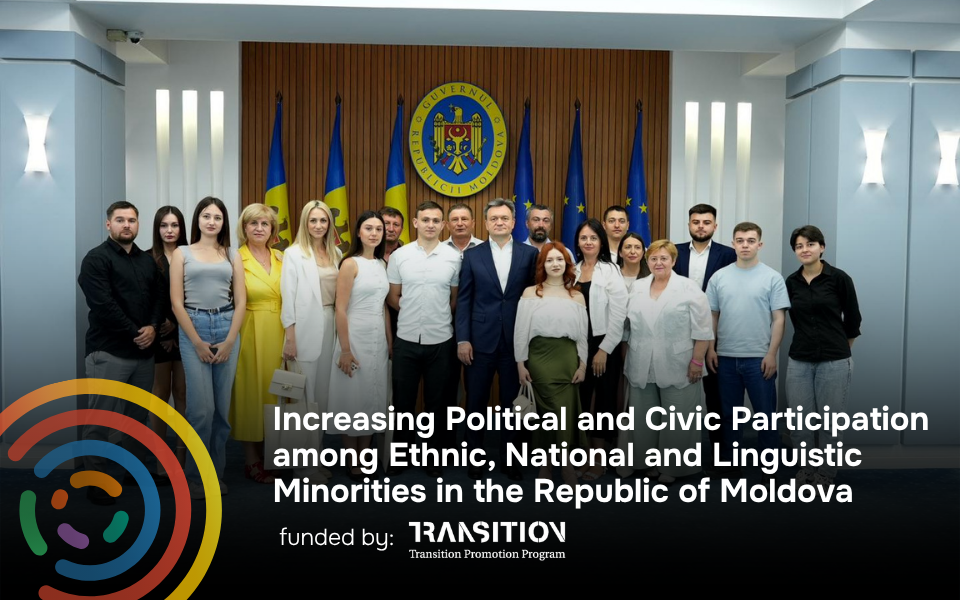
Increasing Political and Civic Participation among Ethnic, National and Linguistic Minorities in the Republic of Moldova
The “Increasing Political and Civic Participation among Ethnic, National and Linguistic Minorities in the Republic of Moldova” project was implemented by the Centre for Civic Initiatives for National Minorities with the support of the Government of the Czech Republic through the TRANSITION programme.
The problem addressed by the project: The Republic of Moldova is a multi-ethnic state in which ethnic, national and linguistic minorities, particularly Russian-speaking communities, represent a significant part of the population. In recent years, these groups have faced increasing political and social isolation caused by a combination of internal and external factors.
One of the key challenges is the active spread of disinformation and propaganda targeting ethnic minorities, particularly through Russian-language media and social networks. These information flows create distorted perceptions of political processes, undermine trust in state institutions and strengthen support for populist and pro-Russian political forces, including in regions such as the Autonomous Territorial Unit of Gagauzia and Taraclia District.
The situation is worsened by the low level of political literacy among the population, especially in regions where minorities live in compact communities. In many cases, citizens do not have a sufficient understanding of how state institutions function, what powers public authorities have or how they can participate in decision-making processes. This leads to political apathy, low participation in democratic processes and growing distrust in the authorities.
An additional problem is the lack of sustainable and systematic dialogue between representatives of ethnic communities and central authorities. The lack of communication and involvement means that the needs and problems of minorities remain insufficiently represented in decision-making processes, increasing feelings of marginalisation and alienation.
The objective of the project is to increase the political and civic engagement of ethnic, national and linguistic minorities in the Republic of Moldova through the development of interethnic dialogue, the improvement of political literacy and the creation of a new generation of active citizens and leaders in regions where minorities live in compact communities.
As part of the project, a special programme of interethnic dialogues (#MinorityDialogues) was developed and implemented between representatives of ethnic communities and public authorities at all levels.
Specifically, the project organised a series of 5 interethnic dialogues (#MinorityDialogues) in Gagauzia, Taraclia, Edineț, Drochia and Chișinău. The dialogues brought together representatives of the Government, pro-European forces and state institutions, as well as representatives of ethnic minorities, young people, local authorities, civic activists and community leaders. Each event brought together at least 50 participants (more than 250 participants in total).
This initiative contributed to establishing direct dialogue between the state and ethnic communities, reducing distrust and creating a platform for discussing the current problems and needs of minorities.
Creating a series of informational videos in minority languages
As part of the project, 25 short videos in minority languages—Russian, Gagauz, Bulgarian and Ukrainian—were developed and distributed to increase public knowledge of the powers of Moldova’s authorities and improve political literacy.
The topics included information about:
- the distribution of power in the Republic of Moldova;
- the functions of the President, Parliament and Government;
- the role of ministries and local public authorities;
- the responsibilities of state representatives.
The videos were distributed through social networks—Instagram, Facebook and TikTok—as well as through targeted advertising, ensuring broad audience reach. In total, the media campaign generated 980,000 views.
This activity helped increase political literacy among ethnic minorities, address common misconceptions about the functions of public authorities and stimulate interest in participating in political and civic processes.
Summer Academy on Minority Rights
An annual Summer Academy was organised, bringing together 20 young people from ethnic, national and linguistic minorities.
As part of the Academy, participants completed an intensive educational programme covering:
- human rights and minority rights;
- national and international mechanisms for protecting rights;
- the functioning of public and international institutions;
- civic activism and participation;
- media education and critical thinking;
- project management.
Participants also worked in teams with mentors to develop their own initiatives aimed at addressing problems in their communities. These initiatives received financial support. By the end of the project, 5 participant-developed initiatives had been implemented.
The Academy contributed to developing leadership skills, strengthening active civic positions and creating a network of young leaders capable of influencing the development of their regions.