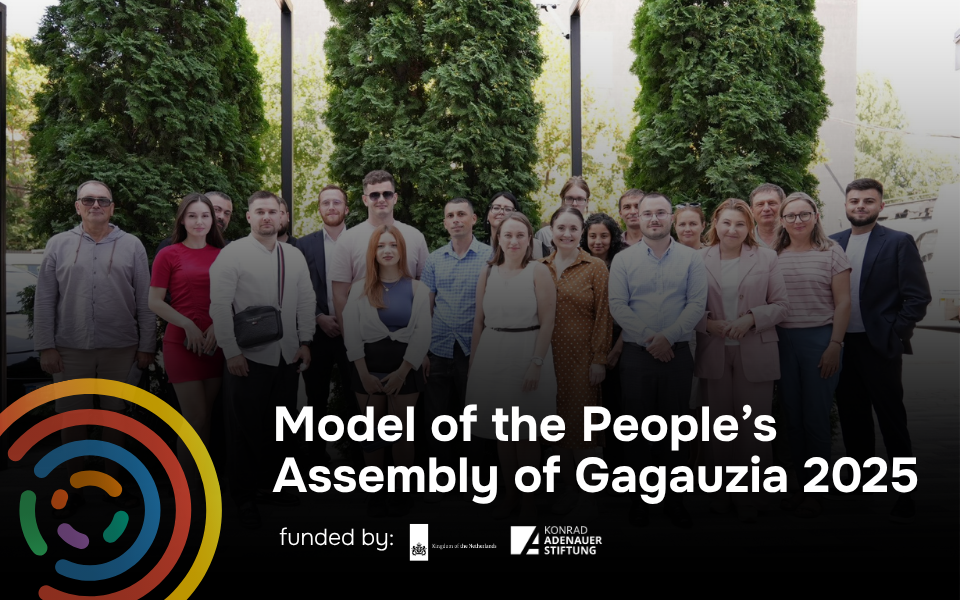
Model of the People’s Assembly of Gagauzia 2025
The “Model of the People’s Assembly of Gagauzia 2025” project was implemented by the Centre for Civic Initiatives for National Minorities with the support of the Embassy of the Kingdom of the Netherlands in Moldova and the Konrad Adenauer Foundation in Moldova.
The problem addressed by the project: The “Model of the People’s Assembly of Gagauzia” project aimed to address one of the region’s key problems—the low level of civic and political engagement, particularly among young people, in decision-making processes and public life.
Today, the People’s Assembly of Gagauzia is often perceived as a closed and hardly accessible institution, with limited transparency and almost no mechanisms for citizen participation. Information about the institution’s work is limited, while opportunities for direct dialogue with the population and citizen involvement in the legislative process remain minimal. This leads to declining trust in public institutions, political apathy and a lack of interest among young people in participating in the governance of the region.
The project was designed as an interactive educational platform aimed at helping young people understand how regional public institutions function, develop critical thinking and encourage civic activism.
The objective of the project is to increase political literacy and civic engagement among young people in Gagauzia through practical training, the simulation of legislative processes and direct interaction with representatives of public authorities.
The project involved 20 young people from Gagauzia, who completed a comprehensive educational and practical programme. During the project, more than 20 training meetings were organised. Participants studied the fundamentals of state organisation, the legislative process and the functioning of the People’s Assembly of Gagauzia. They also developed their critical-thinking, public-speaking and argumentation skills.
The key element of the project was a simulation of the work of the People’s Assembly, designed to be as close as possible to real-life conditions. Participants took on the roles of members of the Assembly, representatives of the executive branch and civil society. They developed their own legislative initiatives, discussed them in a debate format and made decisions through voting. This provided participants with unique practical experience of taking part in the legislative process and helped them better understand decision-making mechanisms.
In addition, more than 10 meetings were organised with politicians, civil servants, experts and diplomats. These meetings gave participants the opportunity to ask questions, discuss current regional issues and establish direct dialogue with representatives of public authorities and the international community.
The project also included a practical component. Participants worked on their own initiatives and proposals aimed at regional development, which helped develop their sense of responsibility for the processes taking place in society.
As a result of the project:
- a group of 20 young participants was formed, with basic knowledge of how public authorities and legislative processes function;
- the level of political literacy and interest in public life among young people increased significantly;
- participants gained practical experience in decision-making through the simulation of legislative activities;
- critical thinking, argumentation, public-speaking and teamwork skills were developed;
- dialogue between young people and representatives of public authorities, expert and diplomatic communities was strengthened;
- trust in state institutions increased through direct interaction;
- a foundation was created for the participants’ further involvement in civic and political activities.
The project demonstrated that practice-oriented educational initiatives are an effective tool for increasing civic activism and political literacy among young people.
The “Model of the People’s Assembly of Gagauzia” became a unique platform that enabled young people not only to understand how public authorities work, but also to recognise their own role in these processes. This represents an important step towards developing a new generation of active and responsible citizens in the region.